
Japanese Mexican Hibakusha and the Swedish Embassy Passport
Two Boys, Two Atomic Bombs: The Japanese Mexican Hibakusha of 1945
The passport that carried Fernando Hiramuro out of Japan came from the Swedish embassy in Tokyo. Sweden was acting for Mexico there, and Fernando was a Mexican-born schoolboy who had been 20 kilometers from Hiroshima when the bomb fell. His story and the story of Yasuaki Yamashita of Nagasaki make up this account of two Japanese Mexican hibakusha, survivors of the atomic bombings. I’m telling it as passport history because the document is what let this family travel at all. The account first appeared in 2016 at Discover Nikkei, and I’ve retold it here for this site.
Sixteen and bound for a sugar plantation in Peru
Toraichi Hiramuro, Fernando’s father, reached Peru in 1907 at the age of 16 to work on a sugar plantation. He was one of 100,000 emigrants from Hiroshima Prefecture who left for the Americas in the first decades of the twentieth century. The plantation conditions were exploitative enough that he moved to Lima and worked as a gardener instead, and he saved for a boat passage north with a plan: reach Mexico, then cross into the United States as a bracero, a guest worker.
He got as far as Guaymas, Sonora, in 1912, in the middle of the Mexican Revolution. Southern Pacific was hiring large numbers of Chinese and Japanese workers there to build the main rail lines linking the U.S. border to Guadalajara, and Toraichi joined as a gardener’s assistant at the small hospital the company ran for its employees in Empalme, Sonora. He rose to nurse’s assistant and decided to stay in Mexico for good. Near the end of the 1920s, with a large new company hospital in Guadalajara, Southern Pacific sent him to San Francisco to learn to operate an X-ray machine. He ended up directing the X-ray department and earning a good salary in dollars.
In early 1930 he spent his savings on a trip to Hiroshima to find a wife. Most emigrants married women they knew only through letters. Toraichi met Kiyoko Hirotani in person and married her. Clara Sumie was born in Guadalajara in 1931, Fernando Minoru two years later, Concepción Michie in 1939. With the family’s savings, the Hiramuros planned to settle in Japan permanently, and in the fall of 1940 all five traveled to Hiroshima, where Fernando started elementary school. Toraichi went back to his job in Guadalajara, meaning to follow later.
The plan stalled. Once Mexico and Japan broke off relations, all contact with his family stopped, along with any money he could send. Kiyoko owned a house in Hiroshima that she could rent out, and that income carried them through the war years, even as goods got scarcer every year.
Windows blown out of a Buddhist temple
On the morning of August 6, 1945, Fernando was lined up with his classmates for the daily ceremony of short speeches and the mandatory greeting to the Emperor. In April the authorities had sent third to sixth graders out of the cities because of the bombing risk, and his school had relocated to Tsuta, a farming town of rice fields and clear streams 20 kilometers from Hiroshima. The children lived and studied in a Buddhist temple. Food was rationed more strictly each month, and most of them went to school without shoes or in sandals made of rice straw.
At 8:15 a.m., before the ceremony ended, Fernando saw a flash like thousands of lightning strikes at once and was blinded for a moment. He heard no unusual noise. Far off, a huge column of smoke rose, and then the blast wave arrived and blew out every window of the temple. The hills around Tsuta kept the students from grasping what had happened to the city.
The first news came in the late afternoon, from people walking back into town with burns. Nobody knew yet that an atomic bomb had done it. The students stayed at school, and Fernando didn’t learn for weeks that his family had survived. His mother wrote that she and little Concepción had been at a neighborhood meeting when it exploded, and that Clara, working in a factory with her high school classmates, was unharmed, though she had seen thousands of deaths. Clara and the others had run to a nearby forest, afraid of a second explosion, and she got home the next day. The house was still standing, but tilted and badly damaged, so for several days the family and Fernando’s grandmother slept in a plantation near it.
At noon on August 15 the students gathered in the temple for the Emperor’s radio message. Hirohito announced Japan’s surrender, but his wording confused the students and many adults. Only the next day did officials come to the school to explain it. The children, who like everyone around them had expected Japan to win, were deeply disappointed.
In early September the school went back to its Hiroshima campus, and Fernando saw the city for the first time since the bomb. The station roof was gone and much of the building was charred. It was raining, and with no electricity the city sat in darkness. Classes resumed the next day, though the first week went to cleaning and repair. The students found splinters of wood and shards of glass everywhere. There was no glass to replace the broken windows, so everyone sat through lessons in the freezing wind. Classes ran in the mornings only, which left Fernando time to repair his own house. The earthen wall panels had fallen, and the family reattached them to bamboo mesh. With the neighbors’ help and several hydraulic jacks, they straightened the house.
A Singer sewing machine from Mexico
Kiyoko Hiramuro had brought a Singer sewing machine with her from Mexico, and after the bomb it became the family’s income. Nobody could buy new clothes, so people needed old ones mended. She repaired hundreds of jackets and wool coats, reusing the linings, which were less worn than the rest. Customers without money paid in goods. Kiyoko took packs of cigarettes and traded them for fresh vegetables and rice from farmers on the edge of the city.
The rent from her house in the city center was gone, since the house had burned. The shortage of food got worse, and the account says these years were as hard as the war years or harder. The occupation authorities asked for millions of tons of food aid, which was distributed to head off riots.
Two pieces of good news arrived in 1946. A letter came from Toraichi in Guadalajara, the first after communication resumed, saying that food and medical aid had been authorized, the kind immigrants in the Americas had begun sending to relatives in large quantities. And Fernando finished elementary school and entered high school, which made the family proud.
Why did a Swedish embassy issue the passport?
The Swedish embassy in Tokyo issued the Hiramuro family’s passports because it represented Mexico’s interests in Japan after the two countries broke off relations. In 1946, thousands of emigrants’ children who had been born in and held citizenship in countries of the Americas filed requests to return. The requests were finally granted in 1950. Permission to leave could only come from the U.S. authorities, and the Swedish embassy then granted the family the passports they needed to travel.
Toraichi bought tickets on a boat to San Francisco and was waiting there when it arrived. Because he worked for Southern Pacific, the reunited family rode first-class train coaches the rest of the way to Guadalajara.
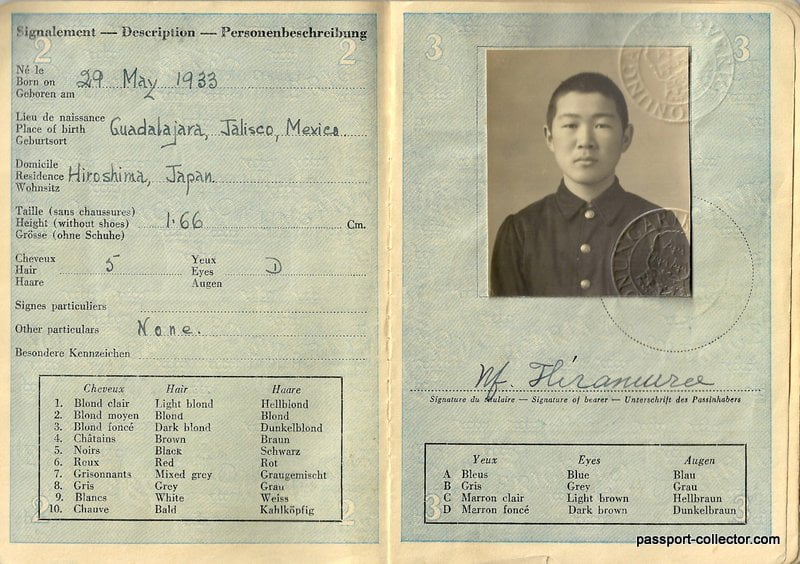
The account gives no issue date or number for the passport, and the Swedish embassy’s own records on the family would be the natural place to look for both. For passport history, the detail that matters is who issued it: a third country, acting for Mexico, in a Japan still under U.S. occupation. It’s the kind of document a passport archive should want.
Back in sixth grade, with no Spanish left
Fernando’s schooling in Japan didn’t count in Mexico, so he was put back into sixth grade. The family had been apart for more than 10 years, and the children had forgotten how to speak Spanish. He chose to repeat the year anyway, finished high school, and enrolled at the University of Guadalajara to study medicine. He specialized in orthopedics, earned his degree with the highest honors, and taught generations of doctors at that university for more than 50 years.
He married Margarita Shoji, who was born in Mexico to Japanese parents. His sister Clara died in 1957, and Fernando died in 2014. When the account was first published in 2016, Concepción was living in Guadalajara.
Nagasaki, 11:02 a.m.
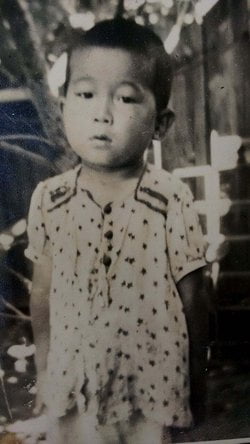
Yasuaki Yamashita was born in Nagasaki in 1939, and war was all he had known. Japan had been occupying parts of China since 1931, and the Japanese call that long stretch of sacrifice the kurai tanima, the dark valley. He still found time to trap crickets and cicadas in the mountains near home with his friends. The children were used to the sirens that announced American bombers, and everyone knew to head for an air raid shelter when one sounded.
His mother took him to meetings of the tonarigumi, the neighborhood associations where residents organized and received military training. Near the end of the war, women were being taught to use bamboo spears against a U.S. army that might land. The military’s propaganda insisted Japan couldn’t lose while also promoting gyokusai, the idea that dying honorably beat surrender.
Yasuaki’s family was large: his parents, three older brothers recruited into the army, and three sisters still in school. His father worked for Mitsubishi, the zaibatsu that built weapons and airplanes and ran the Nagasaki shipyards. According to the account, that made it one of the targets chosen by the U.S. army.
On August 9 he hadn’t gone out with his friends to hunt insects. At 11:02 a.m., after the siren and the radio warned that an enemy plane was approaching, he went into the house with his mother and one of his sisters, heading for the shelter underneath. Before they got there, an intense light blinded them and a tremendous force threw them to the ground. Why the United States dropped a second bomb is the subject of DW’s documentary on Nagasaki, and I’ll leave that question to the film.

His mother covered him with her body. They crawled through the dark into the shelter while objects flew around them. Only the columns holding up the roof and a few walls of the house were left. Yasuaki’s sister said oil had fallen on her head. It was blood from cuts by broken glass. After a few minutes they began walking toward a shelter in the mountains, from where they could see the few buildings still standing and fires all around.
His father, sisters and friends reached the community shelter too. One of the girls had burns across her back and died the next day. On the authorities’ instructions, his father and hundreds of other volunteers went to the epicenter to help survivors and found thousands of bodies. He worked day and night in that area, was exposed to intense radiation, fell suddenly ill, and died several months later.
Crossing out the Emperor in the textbooks
After the surrender, the schools in Nagasaki still used the war-era textbooks, and the children crossed out the paragraphs that praised the Emperor and Japan’s militarism. Yasuaki entered primary school in those months. Most of the children went barefoot or in mended clothes, because new goods could only be had on the black market at exorbitant prices.
Food was the worst of it. His mother took the children to relatives outside the city to find something to eat, and the walk led through the area where the bomb had fallen, past thousands of charred bodies that couldn’t be removed. They came back to Nagasaki after a few days, since provisions were short everywhere, and patched the largest holes in the house with burned walls and salvaged material so they wouldn’t have to sleep outdoors. The U.S. army distributed provisions in the schools. Yasuaki still remembers the day he drank powdered milk and ate raisins and crackers that tasted to him like manna from heaven.

Both sides had been fed propaganda, Japan’s casting the American soldiers as horned demons and America’s casting the Japanese as a horde of fanatics. The account says the soldiers found people ready to help, and the Japanese found an army that was disciplined, educated and orderly, even friendly.
Yasuaki’s sister went to work to bring in some money, and after his father died Yasuaki delivered newspapers.
Fainting spells and the hospital for survivors
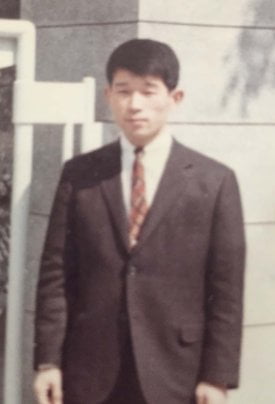
When Yasuaki was about to finish high school, he began hemorrhaging without warning and fainting from sudden anemia. Tests showed no cause, and the account says none has been found to this day. The fainting kept him from holding a permanent job, since he often ended up in the hospital. In 1960 he started as a department administrator at the Japanese Red Cross Hospital for atomic bomb survivors, the Nagasaki Genbaku Byoin.
The job wasn’t only paperwork. He grew close to the patients: babies born with deformities, and many people with cancers caused by radiation. One young man his age had leukemia, and Yasuaki gave him blood each time he needed it. When the young man’s health failed and he died, it marked Yasuaki, and every mirror reminded him he could fall ill at any time.
Outside the hospital there was discrimination built on an unfounded fear that the diseases of the irradiated could be caught. Young women were rejected, and finding a husband was hard for them, because people feared their children would be born with birth defects. Yasuaki began hiding that he had survived the bombing and wouldn’t talk about it. The writer Kenzaburo Oe, who won the Nobel Prize in literature in 1994, has explained this kind of silence: only survivors have the right to stay quiet, he says, if they want to forget.
What drew a Nagasaki survivor to Mexico?
Yasuaki’s interest in Mexico began with Los Panchos, a trio singing boleros that became so popular in Japan that they recorded their songs in Japanese. Mexican culture, mural painting and the history of the Mesoamerican peoples were attracting attention there too, and a book by the painter Tamiji Kitagawa, who had lived in Mexico before the war, pushed Yasuaki to study the country’s history. He also began studying Spanish with great enthusiasm and dedication.
He had a good job at the hospital, but the patients’ pain and the discrimination around them made him look, almost obsessively, for a way to Mexico. The chance came in 1968, during the Olympic Games in Mexico, when the Japanese delegation needed a young interpreter. He was chosen quickly.
After the Games he stayed on to look for work. He took courses at the National Museum of Anthropology, visited archaeological zones across the country, and studied Nahuatl so he could speak directly with indigenous people. In early 1970, as Japanese companies opened plants and offices in Mexico, he started working as an interpreter and translator for their executives. The work was intense and well paid, and he decided to stay, even applying for Mexican citizenship. He also believed the two cultures were less different than they appeared, and saw common ground between Shinto philosophy and the philosophy of the Mesoamerican peoples.
Querétaro, 1995
In 1995 a group of young people in Querétaro asked this Japanese Mexican hibakusha to talk about his experience, since they knew he had been born in Nagasaki. He flatly refused at first. Then he agreed, and that talk started a run of lectures and conferences that became a kind of therapy for pain he had kept to himself. He went on to join organized groups of atomic bomb survivors in the United States and disarmament organizations in several countries.

He has presented at the United Nations and to various governments. The part he cares most about is working with young people, and he visits many schools in the hope that students will carry his words forward and keep up the fight against atomic weapons.
At 77, when the account first appeared, he was committed to two things: the peace movement and his art. His paintings and pottery have earned him recognition and awards. He lived then in San Miguel de Allende, Guanajuato. Oe has said that when hibakusha decide to speak, they do so with all their energy, and that the rest of us shouldn’t stay passive or merely moved by their stories but should accompany them.
The Hiramuro passport after the train to Guadalajara
The account follows Fernando’s passport only as far as the train to Guadalajara. Nothing in it says where the document went afterward. Does any passport archive still hold the Swedish embassy’s papers on the passports it granted the Hiramuro family?
More passport history from Japan…

Tom Topol | Passport Historian & Author
Featured by BBC, CNN, Financial Times and Newsweek. Awarded by the U.S. Department of State
Contact | Press & Media | Books | Explore 1000+ Expert Articles


