


Diplomatic Passport Douglas MacArthur II
Douglas MacArthur II was a member of the Yale College Class of 1932 and a member of Wolf’s Head Society. His long Foreign Service career included tours as ambassadors to four nations. The nephew and namesake of the famous five-star Army general, MacArthur joined the State Department’s foreign service in 1935. He was named a career ambassador, the highest rank in the service, in 1966 and retired in 1972 after three years as United States ambassador to Iran where he escaped a kidnap attempt in 1970. He held the rank of department counselor from 1953 to 1956 during the Eisenhower administration, coordinating international conferences and working on the Austrian state treaty. He was the principal U.S. negotiator of the treaty that established the Southeast Asia Treaty Organization. He was assistant secretary of state for congressional relations from 1965 to 1967, during the Johnson administration. Then ambassador to Japan from 1956 to 1961 and also headed the U.S. missions to Belgium and Austria. He played an instrumental role in the Summit Council for World Peace and a key role in the formulation of the Summit Council’s International Commission for the Reunification of Korea. Survivors include a daughter, two grandchildren, and two great-grandchildren. He died at Georgetown University Hospital at age 88 after a stroke and heart attack. Diplomatic Passport Douglas MacArthur II
The Passport Diplomatic Passport Douglas MacArthur II
A United States Diplomatic passport as Ambassador to Japan issued in 1957 with visas for Hong Kong, Korea, and Japan. Diplomatic Passport Douglas MacArthur II
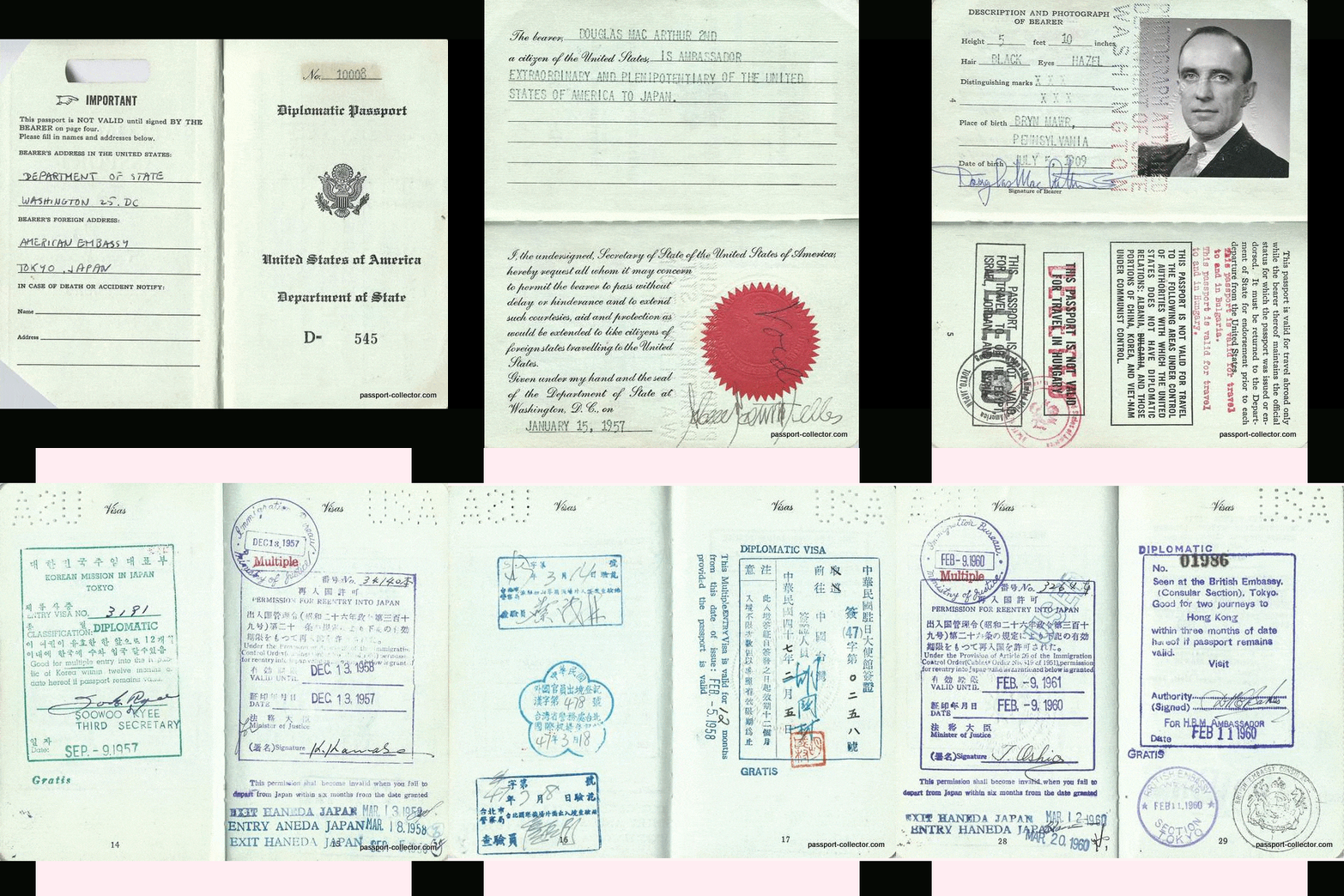
Douglas MacArthur II (1909–1997) Diplomatic Career
State of Residence: District of Columbia
- Counselor
Appointed: March 11, 1953
Entry on Duty: March 30, 1953
Termination of Appointment: December 16, 1956 - Ambassador Extraordinary and Plenipotentiary (Belgium)
Appointed: February 24, 1961
Presentation of Credentials: May 9, 1961
Termination of Mission: Left post on February 11, 1965 - Career Ambassador
Appointed: August 22, 1964 - Assistant Secretary of State for Legislative Affairs
Appointed: March 11, 1965
Entry on Duty: March 14, 1965
Termination of Appointment: March 6, 1967 - Ambassador Extraordinary and Plenipotentiary (Austria)
Appointed: April 5, 1967
Presentation of Credentials: May 24, 1967
Termination of Mission: Left post on September 16, 1969 - Ambassador Extraordinary and Plenipotentiary (Iran)
Appointed: September 15, 1969
Presentation of Credentials: October 13, 1969
Termination of Mission: Left post on February 17, 1972
Source: Office of the Historian, Foreign Service Institute United States Department of State
Watch here a TV interview with MacArthur II on Vietnam. Diplomatic Passport Douglas MacArthur II
Douglas MacArthur II recalls why the United States originally supported the French in Vietnam. MacArthur explains that at the time there was a belief that if Vietnam fell, soon after it would be followed by Cambodia, Thailand, Malaysia, Indonesia, and the Philippines, and therefore it would serve as a sign that anyone who resisted the Viet Minh would be supported.
FAQ Passport History
Passport collection, passport renewal, old passports for sale, vintage passport, emergency passport renewal, same day passport, passport application, pasaporte passeport паспорт 护照 パスポート جواز سفر पासपोर्ट
1. What are the earliest known examples of passports, and how have they evolved?
The word "passport" came up only in the mid 15th Century. Before that, such documents were safe conducts, recommendations or protection letters. On a practical aspect, the earliest passport I have seen was from the mid 16th Century. Read more...
2. Are there any notable historical figures or personalities whose passports are highly sought after by collectors?
Every collector is doing well to define his collection focus, and yes, there are collectors looking for Celebrity passports and travel documents of historical figures like Winston Churchill, Brothers Grimm, Johann Wolfgang von Goethe. Read more...
3. How did passport designs and security features change throughout different periods in history, and what impact did these changes have on forgery prevention?
"Passports" before the 18th Century had a pure functional character. Security features were, in the best case, a watermark and a wax seal. Forgery, back then, was not an issue like it is nowadays. Only from the 1980s on, security features became a thing. A state-of-the-art passport nowadays has dozens of security features - visible and invisible. Some are known only by the security document printer itself. Read more...
4. What are some of the rarest and most valuable historical passports that have ever been sold or auctioned?
Lou Gehrig, Victor Tsoi, Marilyn Monroe, James Joyce, and Albert Einstein when it comes to the most expensive ones. Read more...
5. How do diplomatic passports differ from regular passports, and what makes them significant to collectors?
Such documents were often held by officials in high ranks, like ambassadors, consuls or special envoys. Furthermore, these travel documents are often frequently traveled. Hence, they hold a tapestry of stamps or visas. Partly from unusual places.
6. Can you provide insights into the stories behind specific historical passports that offer unique insights into past travel and migration trends?
A passport tells the story of its bearer and these stories can be everything - surprising, sad, vivid. Isabella Bird and her travels (1831-1904) or Mary Kingsley, a fearless Lady explorer.
7. What role did passports play during significant historical events, such as wartime travel restrictions or international treaties?
During war, a passport could have been a matter of life or death. Especially, when we are looking into WWII and the Holocaust. And yes, during that time, passports and similar documents were often forged to escape and save lives. Example...
8. How has the emergence of digital passports and biometric identification impacted the world of passport collecting?
Current modern passports having now often a sparkling, flashy design. This has mainly two reasons. 1. Improved security and 2. Displaying a countries' heritage, icons, and important figures or achievements. I can fully understand that those modern documents are wanted, especially by younger collectors.
9. Are there any specialized collections of passports, such as those from a specific country, era, or distinguished individuals?
Yes, the University of Western Sidney Library has e.g. a passport collection of the former prime minister Hon Edward Gough Whitlam and his wife Margaret. They are all diplomatic passports and I had the pleasure to apprise them. I hold e.g. a collection of almost all types of the German Empire passports (only 2 types are still missing). Also, my East German passport collection is quite extensive with pretty rare passport types.
10. Where can passport collectors find reliable resources and reputable sellers to expand their collection and learn more about passport history?
A good start is eBay, Delcampe, flea markets, garage or estate sales. The more significant travel documents you probably find at the classic auction houses. Sometimes I also offer documents from my archive/collection. See offers... As you are already here, you surely found a great source on the topic 😉
Other great sources are: Scottish Passports, The Nansen passport, The secret lives of diplomatic couriers
11. Is vintage passport collecting legal? What are the regulations and considerations collectors should know when acquiring historical passports?
First, it's important to stress that each country has its own laws when it comes to passports. Collecting old vintage passports for historical or educational reasons is safe and legal, or at least tolerated. More details on the legal aspects are here...
Does this article spark your curiosity about passport collecting and the history of passports? With this valuable information, you have a good basis to start your own passport collection.
Question? Contact me...