


Nazi Document For A Egyptian Princess
Princess Fawkia (Fawkie) Fouad (This document is for sale)
Born on Oct 6, 1897. She was of the children of Princess Shioh Kar, the first wife of King Fuad I, after their first son, Prince Ismail, died just one-year-old. She is also the half-sister of King Farouk and his sisters.
Fawkie married Mahmoud Fakhrib Pasha and bore him one son, Ahmed. Their palace overlooked the Nile in the Dokki area and has now been converted into a building attached to the State Council. Princess Fawqia sold Dokki Palace to her sister, Princess Faeqa, to live in with her husband, Fouad Ahmed Sadek, after their return from America in 1950.
She died in a luxury hotel in Switzerland
According to Royalstory.blogspot.com, she lived totally alienated at the famous Hotel Dolder in the hills of the city of Zurich, Switzerland, until she died in 1974 at age 76. President Anwar Sadat allowed her to be buried in Egypt. Due to her lifestyle, there are no suitable photographs of her available.
Thanks to FB:@royalstory.page for the research support, as so little is known about this Princess.
At first, I thought the document belonged to Fawzia Fuad…
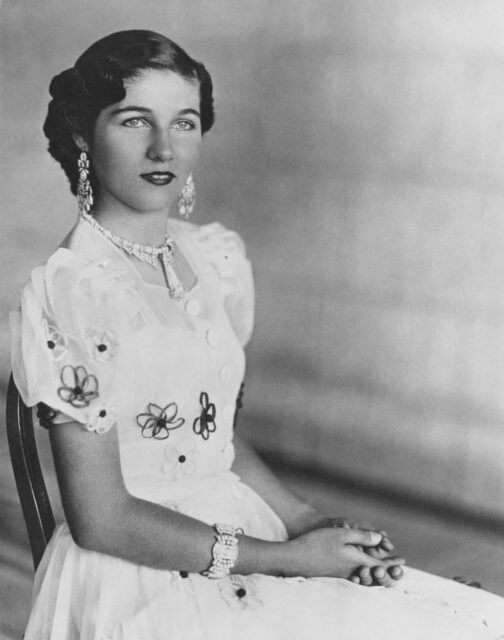
Fawzia Fuad (1921–2013) was an Egyptian Princess
who became the first wife of the late Mohammad Reza Shah Pahlavi in 1939 when she was only 17 years old. The marriage officially ended in 1945 when Egypt granted her a divorce, which Iran recognized three years later. As part of the divorce agreement, their only child, Princess Shahnaz (1940-), was brought up in Iran. Nazi Document Egyptian Princess
On March 16, 1939, with the world on the brink of war, the Middle East rejoiced at a wedding of empires.
Britain as Matchmaker
It was a union heavy with political significance, with Britain playing the part of a matchmaker to strengthen the links between Iran and Egypt. Educated in Switzerland, Princess Fawzia first met Mohammad Reza Pahlavi, who became the Shah of Iran two years later, on their wedding day and only after the marriage contract had been drawn.
“The blessed royal marriage,” as local newspapers called it, received saturation coverage in the media, down to the gifts brought over by the groom, three precious pearl necklaces, a diamond ring, a mirror, and a beautifully hand-printed Quran photographed for the public to see. Nazi Document Egyptian Princess

Queen of Iran
It was a marriage that lasted barely ten years, producing a single daughter, Princess Shahnaz Pahlavi. The divorce was officially attributed to the health risk posed to the queen by the “Persian climate.” But during that time, the Egyptian princess, who looked like a movie star, became one of the most recognized faces in the world, captured on the cover of Life magazine in September 1942 as the “Queen of Iran” by the legendary photographer Cecil Beaton.
The queen, Beaton wrote: “Had sad and mournful eyes, pitch-black hair, a perfectly sculpted face and soft, graceful hands bereft of the wrinkles of labor.” Nazi Document Egyptian Princess
While the Egyptian media celebrated Princess Fawzia as a force to elevate the status of women in society, the Western media portrayed her as a spoiled, wealthy princess whose pictures adorned the cover of fashion magazines.
Princess Fawzia
The Egyptian newspaper Al-Ahram announced the birth of Princess Fawzia on November 5, 1921, at the Ras El Tin Palace on the Mediterranean Sea in Alexandria, Egypt. She was the eldest daughter of Sultan Fuad I and his second wife, Nazli Sabri. Princess Fawzia studied in Switzerland and was fluent in English and French, in addition to her native language, Arabic.
Born in Monaco, Fawzia, a postgraduate from the Institute of Political Studies, works in media and communications in Paris. The few remaining members of the Egyptian royal family reside in Europe. This followed the exile of King Farouq to Italy, where he eventually passed away. The royal family is of Albanian, Circassian, and French descent. Nazi Document Egyptian Princess
Campaigning for women’s rights
Contrary to Western media reports, Fawzia wasn’t a spoiled princess; she tirelessly advocated for women’s rights. She continued her activism during her marriage to the late Shah and after her divorce. Following the 1952 Egyptian Revolution, her assets were seized by the state. The Egyptians held her in high esteem throughout her life and always addressed her as the princess.
“She was beautiful but languidly shy,” wrote a former General of Pahlavi in his memoirs. “She was, in no way, willing to attend official banquets. Whenever she talked to people, her beautiful face turned red.” Nazi Document Egyptian Princess
In 1949, Fawzia re-married Colonel Ismail Chirine, an Egyptian diplomat, with whom she had a son and a daughter. At the time of her death on July 2, 2013, Princess Fawzia was 91 years old.
Fathia, her youngest sister, was killed in 1976 by her ex-husband, who shot her with a revolver six times. Faika, the second-youngest, married an Egyptian commoner in the United States, where she had a civil marriage that her brother, the exiled King Farouq, initially refused to endorse. Princess Faiza was active with the Red Crescent in Egypt during her brother’s reign. All had already passed away.
Princess Fawkia Fouad – Grenzempfehlung
A so-called “Grenzempfehlung” was issued by the German ambassador, Count von Welczeck in Paris on July 28, 1939, for the royal highness, the Princess of Egypt. Based on her diplomatic passport with the number 52 issued by the royal Egypt embassy in Paris. For travel from to Paris. Original signature of Ambassador von Welczeck – a significant figure in Hitler’s Foreign office.
(The French historian Lucas Delattre described Welczeck as a “diplomat of the old school,” well known in Paris for his courtly, suave manners (albeit with an irascible streak) and his fluent French.)
Such a document ensures speedy and unhindered processing at German borders and is valid only in connection with a passport. Given the fact that so little is known about Princess Fawkia, this document is even of greater importance.


The curious case of President Sadat’s Diplomatic Passport
FAQ Passport History
Passport collection, passport renewal, old passports for sale, vintage passport, emergency passport renewal, same day passport, passport application, pasaporte passeport паспорт 护照 パスポート جواز سفر पासपोर्ट
1. What are the earliest known examples of passports, and how have they evolved?
The word "passport" came up only in the mid 15th Century. Before that, such documents were safe conducts, recommendations or protection letters. On a practical aspect, the earliest passport I have seen was from the mid 16th Century. Read more...
2. Are there any notable historical figures or personalities whose passports are highly sought after by collectors?
Every collector is doing well to define his collection focus, and yes, there are collectors looking for Celebrity passports and travel documents of historical figures like Winston Churchill, Brothers Grimm, Johann Wolfgang von Goethe. Read more...
3. How did passport designs and security features change throughout different periods in history, and what impact did these changes have on forgery prevention?
"Passports" before the 18th Century had a pure functional character. Security features were, in the best case, a watermark and a wax seal. Forgery, back then, was not an issue like it is nowadays. Only from the 1980s on, security features became a thing. A state-of-the-art passport nowadays has dozens of security features - visible and invisible. Some are known only by the security document printer itself. Read more...
4. What are some of the rarest and most valuable historical passports that have ever been sold or auctioned?
Lou Gehrig, Victor Tsoi, Marilyn Monroe, James Joyce, and Albert Einstein when it comes to the most expensive ones. Read more...
5. How do diplomatic passports differ from regular passports, and what makes them significant to collectors?
Such documents were often held by officials in high ranks, like ambassadors, consuls or special envoys. Furthermore, these travel documents are often frequently traveled. Hence, they hold a tapestry of stamps or visas. Partly from unusual places.
6. Can you provide insights into the stories behind specific historical passports that offer unique insights into past travel and migration trends?
A passport tells the story of its bearer and these stories can be everything - surprising, sad, vivid. Isabella Bird and her travels (1831-1904) or Mary Kingsley, a fearless Lady explorer.
7. What role did passports play during significant historical events, such as wartime travel restrictions or international treaties?
During war, a passport could have been a matter of life or death. Especially, when we are looking into WWII and the Holocaust. And yes, during that time, passports and similar documents were often forged to escape and save lives. Example...
8. How has the emergence of digital passports and biometric identification impacted the world of passport collecting?
Current modern passports having now often a sparkling, flashy design. This has mainly two reasons. 1. Improved security and 2. Displaying a countries' heritage, icons, and important figures or achievements. I can fully understand that those modern documents are wanted, especially by younger collectors.
9. Are there any specialized collections of passports, such as those from a specific country, era, or distinguished individuals?
Yes, the University of Western Sidney Library has e.g. a passport collection of the former prime minister Hon Edward Gough Whitlam and his wife Margaret. They are all diplomatic passports and I had the pleasure to apprise them. I hold e.g. a collection of almost all types of the German Empire passports (only 2 types are still missing). Also, my East German passport collection is quite extensive with pretty rare passport types.
10. Where can passport collectors find reliable resources and reputable sellers to expand their collection and learn more about passport history?
A good start is eBay, Delcampe, flea markets, garage or estate sales. The more significant travel documents you probably find at the classic auction houses. Sometimes I also offer documents from my archive/collection. See offers... As you are already here, you surely found a great source on the topic 😉
Other great sources are: Scottish Passports, The Nansen passport, The secret lives of diplomatic couriers
11. Is vintage passport collecting legal? What are the regulations and considerations collectors should know when acquiring historical passports?
First, it's important to stress that each country has its own laws when it comes to passports. Collecting old vintage passports for historical or educational reasons is safe and legal, or at least tolerated. More details on the legal aspects are here...
Does this article spark your curiosity about passport collecting and the history of passports? With this valuable information, you have a good basis to start your own passport collection.
Question? Contact me...