


Poet James Joyce British Passport 1915
James Joyce Biography
James Augustine Aloysius Joyce (2 February 1882 – 13 January 1941) was an Irish novelist and poet, recognized as a highly influential figure among the modernist experimental artists of the early 20th century. He achieved prominence for his novel “Ulysses” (1922), a groundbreaking work that refined his stream of consciousness technique, incorporating a wide array of literary devices to present a contemporary reinterpretation of The Odyssey.
Other major works are the short-story collection Dubliners (1914), and the novels A Portrait of the Artist as a Young Man (1916) and Finnegan’s Wake (1939). His complete oeuvre includes three books of poetry, a play, occasional journalism, and his published letters.
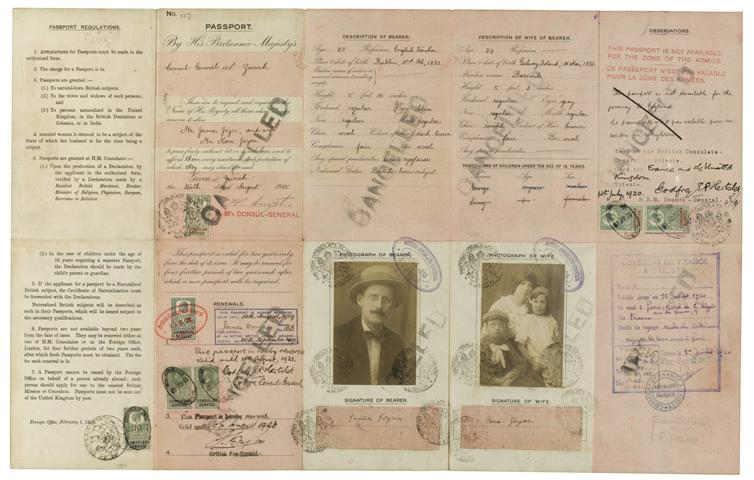
The Passport James Joyce Poet
One double-sided sheet of white and pink paper folded to form 10 panels, printed and manuscript (340 x 535mm), originally valid for two years only. Subsequently, renewed for three periods, on 20 September 1917 (Zurich), 20 October 1919 (Trieste) and 23 February 1922 (Paris). Expiring on 10 August 1923.
An extra British visa was issued in Zurich, coinciding with the initial renewal on 20 September 1917. This visa permits the holder to reside within the Consular District of Zurich on the same date as the first renewal (20 September 1917). Passport James Joyce Poet
Visas Passport James Joyce Poet
Italian and Swiss visas on 19 and 15 October 1919 permitted Joyce’s return to Trieste, with four additional visas in Trieste on 1 July 1920, preceding their move to Paris.
British visa “… Good for the France and the United Kingdom…”. French Visa allowing Joyce and his family to travel to Paris for “recherché littéraires” for three months. Swiss transit Visa and Italian visa for theᅠfor the same journey.
Photographs
Charming black-and-white photos depict Joyce, Nora, Giorgio, and Lucia. They measure 90 x 60mm, bear the couple’s signatures, and British Consulate General stamp (10 August 1915). Passport James Joyce Poet
Description
Joyce, an English teacher with distinctive eyeglasses, bears the British Consulate’s passport stamps in purple, black, red, and green. The passport, signed by four British Consul-Generals (once by the Pro-Consul), displayed stamped visas, including “Chiasso,” “Brigue,” and “Boulogne.”
Some panels bear “canceled” stamps, possibly from Joyce’s passport renewal on May 3, 1924. Slight discoloration noted; original cover remnants on two panels.
ESTIMATE: 50,000 – 70,000 GBP
SOLD for 61,250 GBP
SOTHEBY’S, London, 14th July 2011, LOT 91 – JOYCE, JAMES
The British Passport of Lady Lilly Jones
FAQ Passport History
Passport collection, passport renewal, old passports for sale, vintage passport, emergency passport renewal, same day passport, passport application, pasaporte passeport паспорт 护照 パスポート جواز سفر पासपोर्ट
1. What are the earliest known examples of passports, and how have they evolved?
The word "passport" came up only in the mid 15th Century. Before that, such documents were safe conducts, recommendations or protection letters. On a practical aspect, the earliest passport I have seen was from the mid 16th Century. Read more...
2. Are there any notable historical figures or personalities whose passports are highly sought after by collectors?
Every collector is doing well to define his collection focus, and yes, there are collectors looking for Celebrity passports and travel documents of historical figures like Winston Churchill, Brothers Grimm, Johann Wolfgang von Goethe. Read more...
3. How did passport designs and security features change throughout different periods in history, and what impact did these changes have on forgery prevention?
"Passports" before the 18th Century had a pure functional character. Security features were, in the best case, a watermark and a wax seal. Forgery, back then, was not an issue like it is nowadays. Only from the 1980s on, security features became a thing. A state-of-the-art passport nowadays has dozens of security features - visible and invisible. Some are known only by the security document printer itself. Read more...
4. What are some of the rarest and most valuable historical passports that have ever been sold or auctioned?
Lou Gehrig, Victor Tsoi, Marilyn Monroe, James Joyce, and Albert Einstein when it comes to the most expensive ones. Read more...
5. How do diplomatic passports differ from regular passports, and what makes them significant to collectors?
Such documents were often held by officials in high ranks, like ambassadors, consuls or special envoys. Furthermore, these travel documents are often frequently traveled. Hence, they hold a tapestry of stamps or visas. Partly from unusual places.
6. Can you provide insights into the stories behind specific historical passports that offer unique insights into past travel and migration trends?
A passport tells the story of its bearer and these stories can be everything - surprising, sad, vivid. Isabella Bird and her travels (1831-1904) or Mary Kingsley, a fearless Lady explorer.
7. What role did passports play during significant historical events, such as wartime travel restrictions or international treaties?
During war, a passport could have been a matter of life or death. Especially, when we are looking into WWII and the Holocaust. And yes, during that time, passports and similar documents were often forged to escape and save lives. Example...
8. How has the emergence of digital passports and biometric identification impacted the world of passport collecting?
Current modern passports having now often a sparkling, flashy design. This has mainly two reasons. 1. Improved security and 2. Displaying a countries' heritage, icons, and important figures or achievements. I can fully understand that those modern documents are wanted, especially by younger collectors.
9. Are there any specialized collections of passports, such as those from a specific country, era, or distinguished individuals?
Yes, the University of Western Sidney Library has e.g. a passport collection of the former prime minister Hon Edward Gough Whitlam and his wife Margaret. They are all diplomatic passports and I had the pleasure to apprise them. I hold e.g. a collection of almost all types of the German Empire passports (only 2 types are still missing). Also, my East German passport collection is quite extensive with pretty rare passport types.
10. Where can passport collectors find reliable resources and reputable sellers to expand their collection and learn more about passport history?
A good start is eBay, Delcampe, flea markets, garage or estate sales. The more significant travel documents you probably find at the classic auction houses. Sometimes I also offer documents from my archive/collection. See offers... As you are already here, you surely found a great source on the topic 😉
Other great sources are: Scottish Passports, The Nansen passport, The secret lives of diplomatic couriers
11. Is vintage passport collecting legal? What are the regulations and considerations collectors should know when acquiring historical passports?
First, it's important to stress that each country has its own laws when it comes to passports. Collecting old vintage passports for historical or educational reasons is safe and legal, or at least tolerated. More details on the legal aspects are here...
Does this article spark your curiosity about passport collecting and the history of passports? With this valuable information, you have a good basis to start your own passport collection.
Question? Contact me...